A point charge of mass is suspended vertically by a string of length . A point dipole of dipole moment is now brought towards from infinity so that the charge moves away. The final equilibrium position of the system including the direction of the dipole, the angles and distances is shown in the figure below. If the work done in bringing the dipole to this position is , where is the acceleration due to gravity, then the value of is ______. (Note that for three coplanar forces keeping a point mass in equilibrium, is the same for all forces, where is any one of the forces and is the angle between the other two forces)
← JEE Advanced 2020 · Paper 2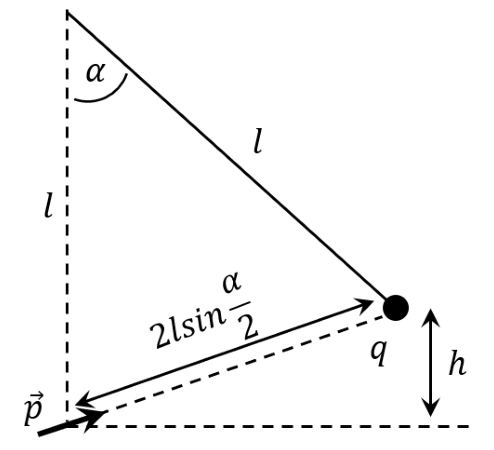
PhysicsInteger+3 / -1Question 5 of 54
JEE Advanced 2020 · Paper 2, Physics question 5
Answer and worked solution
Official answer: 2
Geometry. The pivot, the dipole (at the charge's original position, a distance below the pivot) and the charge form an isosceles triangle. Its apex angle is at the pivot, and its base joins the dipole to the charge.
Force on the charge. The dipole points at , so on its axis and the repulsion is , directed along the base.
Equilibrium (Lami). Measured at the charge:
- the angle between and is ;
- the angle between and is .
Interaction energy.
Work done. The work in bringing the dipole equals the gain in gravitational plus electrostatic energy:
Answer: 2