Skip to content
dronacharya.ai
← JEE Advanced 2020 · Paper 2
ChemistryNumerical+4Question 33 of 54

JEE Advanced 2020 · Paper 2, Chemistry question 15

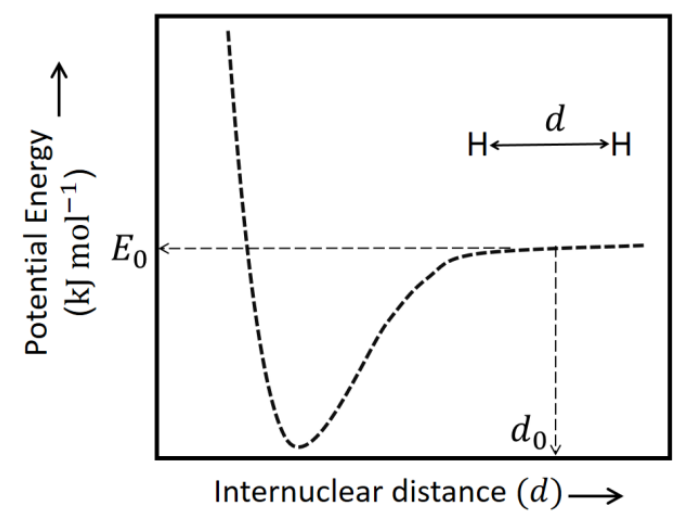
The figure below is the plot of potential energy versus internuclear distance (d)(d) of HX2\ce{H2} molecule in the electronic ground state. What is the value of the net potential energy E0E_0 (as indicated in the figure) in kJ mol−1\mathrm{kJ\,mol^{-1}}, for d=d0d = d_0 at which the electron-electron repulsion and the nucleus-nucleus repulsion energies are absent? As reference, the potential energy of H atom is taken as zero when its electron and the nucleus are infinitely far apart.

Use Avogadro constant as 6.023×10²³ mol−16.023\times10^{23}\ \mathrm{mol^{-1}}.

Potential energy (kJ mol⁻¹) of H₂ against internuclear distance d: a Morse-type curve, steeply repulsive at small d, with a minimum, rising to a flat level E₀ at large separation d₀, where the two H atoms are far apart.
Answer and worked solution

Official answer: -2640

What E0E_0 is. At d0d_0 there is no electron-electron or nucleus-nucleus repulsion: the molecule has separated into two independent ground-state H atoms. So E0E_0 is twice the ground-state energy of an H atom.

Per mole.
E0=2×(−13.6 eV)×1.602×10⁻¹⁹ J eV−1×6.023×1023 mol−1≈−2624 kJ mol−1.E_0=2\times(-13.6\text{ eV})\times1.602\times10^{-19}\ \mathrm{J\,eV^{-1}}\times6.023\times10^{23}\ \mathrm{mol^{-1}}\approx-2624\ \mathrm{kJ\,mol^{-1}}.
Answer: −2624 (key: −2640 to −2620; −5280 to −5240 was also accepted)