Skip to content
dronacharya.ai
← JEE Advanced 2020 · Paper 2
ChemistryMultiple correct+4 / -2Question 30 of 54

JEE Advanced 2020 · Paper 2, Chemistry question 12

Consider the following transformations of a compound P.

Choose the correct option(s).
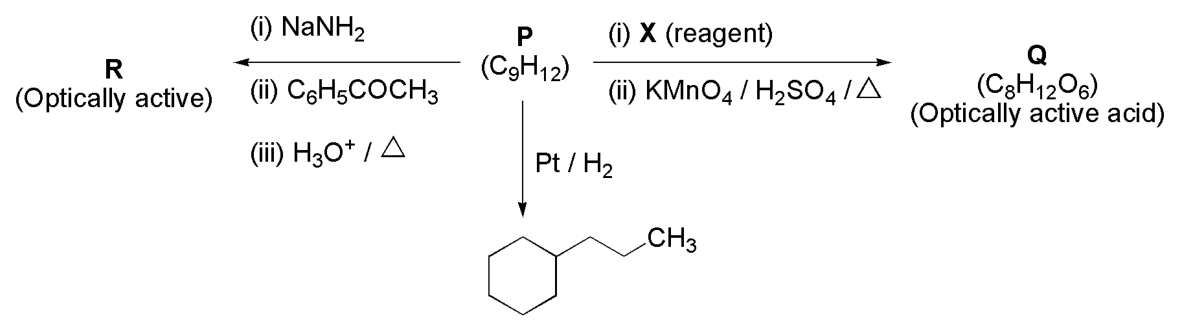
P (C₉H₁₂) with Pt/H₂ gives propylcyclohexane. P with (i) NaNH₂, (ii) C₆H₅COCH₃, (iii) H₃O⁺/Δ gives R (optically active). P with (i) reagent X, (ii) KMnO₄/H₂SO₄/Δ gives Q (C₈H₁₂O₆, an optically active acid).
Choose one or more options
Answer and worked solution

Official answer: B, C

What P must be. P (CX9HX12\ce{C9H12}, 4 degrees of unsaturation) hydrogenates to propylcyclohexane. With NaNHX2\ce{NaNH2} it forms an acetylide, so it is a cyclohexene with a CHX2C≡CH\ce{CH2C#CH} side chain.

Which cyclohexene. Partial reduction of the alkyne with X, then hot KMnOX4\ce{KMnO4}, cleaves both C=C bonds; the terminal =CHX2\ce{=CH2} is lost as COX2\ce{CO2}.

  • If the side chain is at C3, next to the ring C=C, the product is HOX2C−CH(CHX2COX2H)−CHX2CHX2CHX2−COX2H\ce{HO2C-CH(CH2CO2H)-CH2CH2CH2-CO2H}. That is CX8HX12OX6\ce{C8H12O6}, and its CH is a stereocentre, so it is optically active. ✓
  • If the side chain is at C4, the product is HOX2C−CHX2−CH(CHX2COX2H)−CHX2−COX2H\ce{HO2C-CH2-CH(CH2CO2H)-CH2-CO2H}. Two identical arms make it achiral. ✗

So P is the C3 isomer, (C), not (A). X is the Lindlar-type catalyst Pd-C/quinoline/HX2\ce{H2}, (B).

R. The acetylide adds to acetophenone, and acid/heat dehydrates the tertiary alcohol to Ph−C(=CHX2)−C≡C−CHX2X−\ce{Ph-C(=CH2)-C#C-CH2-}(cyclohex-2-enyl). R is optically active because of the ring stereocentre. Option (D) draws the substituent at C4 of the ring, which would be achiral, so (D) is wrong.

(B), (C)