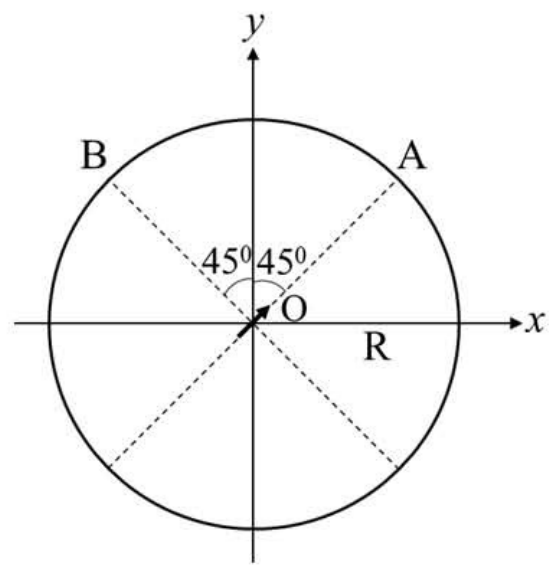
An electric dipole with dipole moment 2p0(i^+j^) is held fixed at the origin O in the presence of an uniform electric field of magnitude E0. If the potential is constant on a circle of radius R centered at the origin as shown in figure, then the correct statement(s) is/are:
(ϵ0 is permittivity of free space. R≫ dipole size)
Answer and worked solution
Official answer: A, C
Condition for an equipotential sphere. With the uniform field E0 parallel to p, the potential is V=r2kpcosθ−E0rcosθ=cosθ(r2kp−E0r). It is zero on the whole sphere r3=kp/E0. (An antiparallel field would give no such sphere.)
(A) R=(4πϵ0E0p0)1/3. True.
(B) A lies on the dipole's axis. There the dipole field is R32kp=2E0 along p^, so the total is 3E0p^=23E0(i^+j^). The option's 2E0(i^+j^) is 2E0p^. False.
(C) B lies on the dipole's equatorial line. There the dipole field is −R3kpp^=−E0p^, which cancels the applied field. True.
(D) The field strength is 3E0 at A and 0 at B, so it is not the same everywhere on the circle. False.