Skip to content
dronacharya.ai
← JEE Advanced 2019 · Paper 1
PhysicsNumerical+3Question 18 of 54

JEE Advanced 2019 · Paper 1, Physics question 18

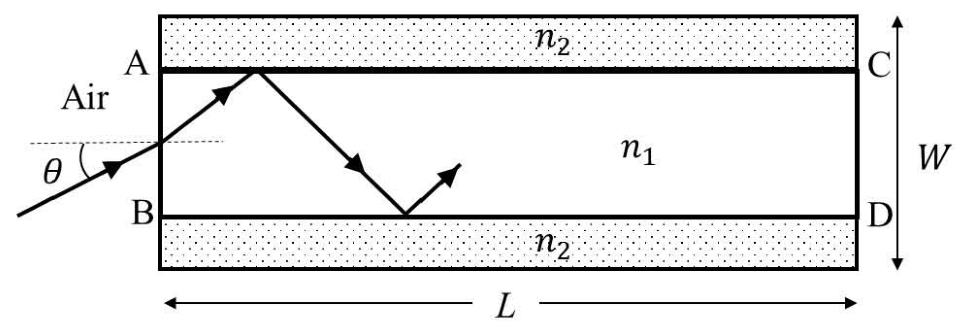
A planar structure of length LL and width WW is made of two different optical media of refractive indices n1=1.5n_1 = 1.5 and n2=1.44n_2 = 1.44 as shown in figure. If L≫WL \gg W, a ray entering from end AB will emerge from end CD only if the total internal reflection condition is met inside the structure. For L=9.6L = 9.6 m, if the incident angle θ\theta is varied, the maximum time taken by a ray to exit the plane CD is t×10−9t\times10^{-9} s, where tt is ______.

[Speed of light c=3×10⁸c = 3\times10^8 m/s]

A slab of length L: a core of index n₁ between two cladding layers of index n₂, total width W. A ray from air hits the end face AB at angle θ, refracts into the core and zigzags along it by total internal reflection towards the far end CD.
Answer and worked solution

Official answer: 49

Slowest ray. A ray takes longest when it zigzags most steeply, i.e. when it meets the core-cladding boundary exactly at the critical angle:
sin⁡θc=n2n1=0.96.\sin\theta_c=\frac{n_2}{n_1}=0.96.

Path and time. The ray then makes angle θc\theta_c with the boundary normal, so its path length is L/sin⁡θcL/\sin\theta_c:
t=n1Lcsin⁡θc=1.5×9.63×108×0.96=5.0×10⁻⁸ s.t=\frac{n_1L}{c\sin\theta_c}=\frac{1.5\times9.6}{3\times10^8\times0.96}=5.0\times10^{-8}\text{ s}.

Check that this ray can enter. It needs sin⁡θ=n1cos⁡θc=1.5×0.28=0.42<1\sin\theta=n_1\cos\theta_c=1.5\times0.28=0.42<1, which is fine.

Answer: 50 (key: 49 to 51)