Schemes 1 and 2 describe the conversion of P to Q and R to S, respectively. Scheme 3 describes the synthesis of T from Q and S. The total number of Br atoms in a molecule of T is ______
← JEE Advanced 2019 · Paper 1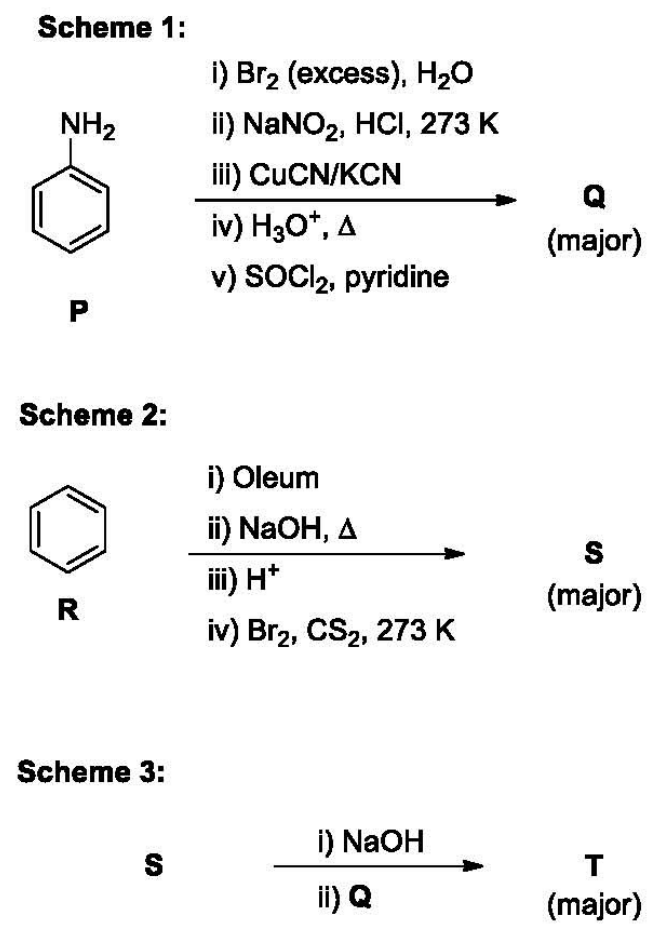
ChemistryNumerical+3Question 36 of 54
JEE Advanced 2019 · Paper 1, Chemistry question 18
Answer and worked solution
Official answer: 4
Q (Scheme 1). Aniline with bromine water gives 2,4,6-tribromoaniline. Diazotisation and CuCN give the nitrile, hydrolysis gives 2,4,6-tribromobenzoic acid, and gives its acid chloride. Q has 3 Br.
S (Scheme 2). Benzene is sulfonated to benzenesulfonic acid, and NaOH fusion then gives phenol. in at 273 K monobrominates it, giving 4-bromophenol. S has 1 Br.
T (Scheme 3). The phenoxide attacks the acid chloride, giving the ester 4-bromophenyl 2,4,6-tribromobenzoate. That is Br.
Answer: 4