An infinitely long thin non-conducting wire is parallel to the -axis and carries a uniform line charge density . It pierces a thin non-conducting spherical shell of radius in such a way that the arc subtends an angle at the centre of the spherical shell, as shown in the figure. The permittivity of free space is . Which of the following statements is (are) true?
← JEE Advanced 2018 · Paper 2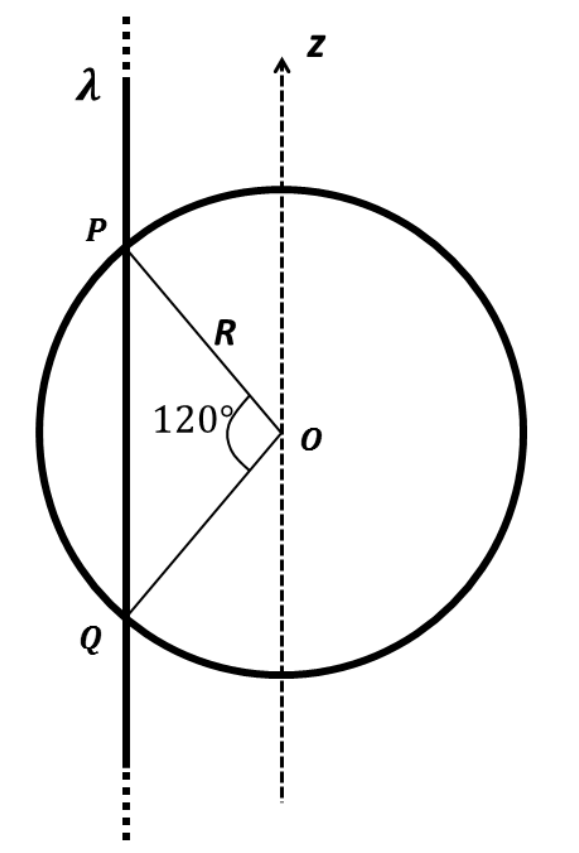
PhysicsMultiple correct+4 / -2Question 3 of 54
JEE Advanced 2018 · Paper 2, Physics question 3
Answer and worked solution
Official answer: A, B
Charge enclosed. Only the chord of the wire is inside the shell. It subtends at the centre, so
Flux. By Gauss's law, . (A) is true and (C) is false.
Direction. An infinite line charge parallel to produces a field perpendicular to itself, i.e. in the -plane. So everywhere, including on the shell. (B) is true.
Normal? The field is radial from the wire, not from the centre , so it is not normal to the sphere in general. (D) is false.
(A), (B)