Skip to content
dronacharya.ai
← JEE Advanced 2018 · Paper 2
ChemistryList match+3 / -1Question 34 of 54

JEE Advanced 2018 · Paper 2, Chemistry question 16

The desired product X can be prepared by reacting the major product of the reactions in LIST-I with one or more appropriate reagents in LIST-II.

(given, order of migratory aptitude: aryl > alkyl > hydrogen)

The correct option is
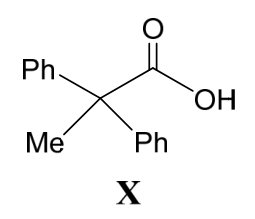
X: 2,2-diphenylpropanoic acid, Ph₂C(Me)-CO₂H

LIST-I

  • P
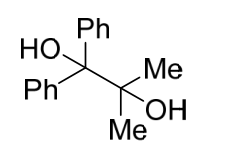
    Ph2C(OH)-C(OH)Me2\mathrm{Ph_2C(OH)\text{-}C(OH)Me_2} + H2SO4\mathrm{H_2SO_4}
    2-Methyl-1,1-diphenylpropane-1,2-diol
  • Q
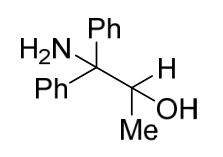
    Ph2C(NH2)-CH(OH)Me\mathrm{Ph_2C(NH_2)\text{-}CH(OH)Me} + HNO2\mathrm{HNO_2}
    1-Amino-1,1-diphenylpropan-2-ol
  • R
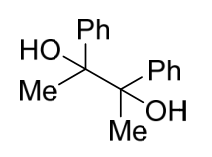
    PhC(OH)(Me)-C(OH)(Me)Ph\mathrm{PhC(OH)(Me)\text{-}C(OH)(Me)Ph} + H2SO4\mathrm{H_2SO_4}
    2,3-Diphenylbutane-2,3-diol
  • S
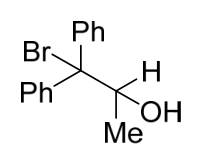
    Ph2C(Br)-CH(OH)Me\mathrm{Ph_2C(Br)\text{-}CH(OH)Me} + AgNO3\mathrm{AgNO_3}
    1-Bromo-1,1-diphenylpropan-2-ol

LIST-II

  • 1
    I2\mathrm{I_2}, NaOH
  • 2
    [Ag(NH3)2]OH[\mathrm{Ag(NH_3)_2}]\mathrm{OH}
  • 3
    Fehling solution
  • 4
    HCHO, NaOH
  • 5
    NaOBr
Choose one option
Answer and worked solution

Official answer: D

Target X is PhX2C(CHX3)COOH\ce{Ph2C(CH3)COOH}. It can come from the methyl ketone PhX2C(CHX3)COCHX3\ce{Ph2C(CH3)COCH3} by the haloform reaction (IX2/NaOH\ce{I2/NaOH} or NaOBr), or from the aldehyde PhX2C(CHX3)CHO\ce{Ph2C(CH3)CHO} by Tollens' or Fehling's oxidation.

  • P. PhX2C(OH)−C(OH)MeX2\ce{Ph2C(OH)-C(OH)Me2} with HX2SOX4\ce{H2SO4} (pinacol): the more stable cation PhX2CX+\ce{Ph2C+} forms, and a methyl migrates from the other carbon. This gives PhX2C(Me)COMe\ce{Ph2C(Me)COMe}, so haloform: 1, 5.
  • Q. PhX2C(NHX2)−CH(OH)Me\ce{Ph2C(NH2)-CH(OH)Me} with HNOX2\ce{HNO2} (semipinacol): PhX2CX+\ce{Ph2C+} forms, and from CH(OH)Me\ce{CH(OH)Me} the methyl (alkyl > H) migrates. This gives PhX2C(Me)CHO\ce{Ph2C(Me)CHO}, so Tollens or Fehling: 2, 3.
  • R. PhC(OH)Me−C(OH)MePh\ce{PhC(OH)Me-C(OH)MePh} with HX2SOX4\ce{H2SO4}: a benzylic cation forms, and phenyl (aryl > alkyl) migrates. This gives PhX2C(Me)COMe\ce{Ph2C(Me)COMe}, so haloform: 1, 5.
  • S. PhX2C(Br)−CH(OH)Me\ce{Ph2C(Br)-CH(OH)Me} with AgNOX3\ce{AgNO3}: AgX+\ce{Ag+} removes BrX−\ce{Br-} to give PhX2CX+\ce{Ph2C+}, and methyl migrates as in Q. This gives PhX2C(Me)CHO\ce{Ph2C(Me)CHO}: 2, 3.

(D)