Skip to content
dronacharya.ai
← JEE Advanced 2018 · Paper 1
ChemistrySingle correct+3 / -1Question 36 of 54

JEE Advanced 2018 · Paper 1, Chemistry question 18

Passage

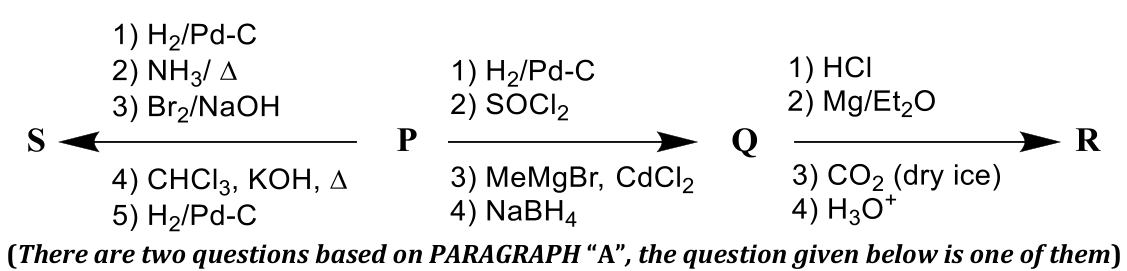
An organic acid P (C11_{11}H12_{12}O2_2) can easily be oxidized to a dibasic acid which reacts with ethyleneglycol to produce a polymer dacron. Upon ozonolysis, P gives an aliphatic ketone as one of the products. P undergoes the following reaction sequences to furnish R via Q. The compound P also undergoes another set of reactions to produce S.

[Scheme: S ← P: 1) H2_2/Pd-C; 2) NH3_3/Δ; 3) Br2_2/NaOH; 4) CHCl3_3, KOH, Δ; 5) H2_2/Pd-C. P → Q: 1) H2_2/Pd-C; 2) SOCl2_2; 3) MeMgBr, CdCl2_2; 4) NaBH4_4. Q → R: 1) HCl; 2) Mg/Et2_2O; 3) CO2_2 (dry ice); 4) H3_3O+^+.]

Reaction scheme: P converts to S (left arrow) with 1) H₂/Pd-C, 2) NH₃/Δ, 3) Br₂/NaOH, 4) CHCl₃, KOH, Δ, 5) H₂/Pd-C; P converts to Q (right arrow) with 1) H₂/Pd-C, 2) SOCl₂, 3) MeMgBr, CdCl₂, 4) NaBH₄; Q converts to R with 1) HCl, 2) Mg/Et₂O, 3) CO₂ (dry ice), 4) H₃O⁺.

The compound S is

Choose one option
Answer and worked solution

Official answer: B

Starting from P, (CHX3)X2C=CH−CX6HX4−COOH\ce{(CH3)2C=CH-C6H4-COOH}:

  1. HX2/Pd−C\ce{H2/Pd-C} gives 4-isobutylbenzoic acid.
  2. NHX3\ce{NH3}, Δ gives the amide.
  3. BrX2/NaOH\ce{Br2/NaOH} (Hofmann bromamide degradation) gives 4-isobutylaniline.
  4. CHClX3\ce{CHCl3}, KOH, Δ (carbylamine reaction) gives the isocyanide, Ar−N≡C\ce{Ar-N#C}.
  5. HX2/Pd−C\ce{H2/Pd-C} reduces the isocyanide to the secondary amine Ar−NH−CHX3\ce{Ar-NH-CH3}.

S is N-methyl-4-isobutylaniline.

(B)