Skip to content
dronacharya.ai
← JEE Advanced 2018 · Paper 1
ChemistryNumerical+3Question 32 of 54

JEE Advanced 2018 · Paper 1, Chemistry question 14

The plot given below shows P−TP-T curves (where PP is the pressure and TT is the temperature) for two solvents X and Y and isomolal solutions of NaCl in these solvents. NaCl completely dissociates in both the solvents.

On addition of equal number of moles of a non-volatile solute S in equal amount (in kg) of these solvents, the elevation of boiling point of solvent X is three times that of solvent Y. Solute S is known to undergo dimerization in these solvents. If the degree of dimerization is 0.7 in solvent Y, the degree of dimerization in solvent X is ______.
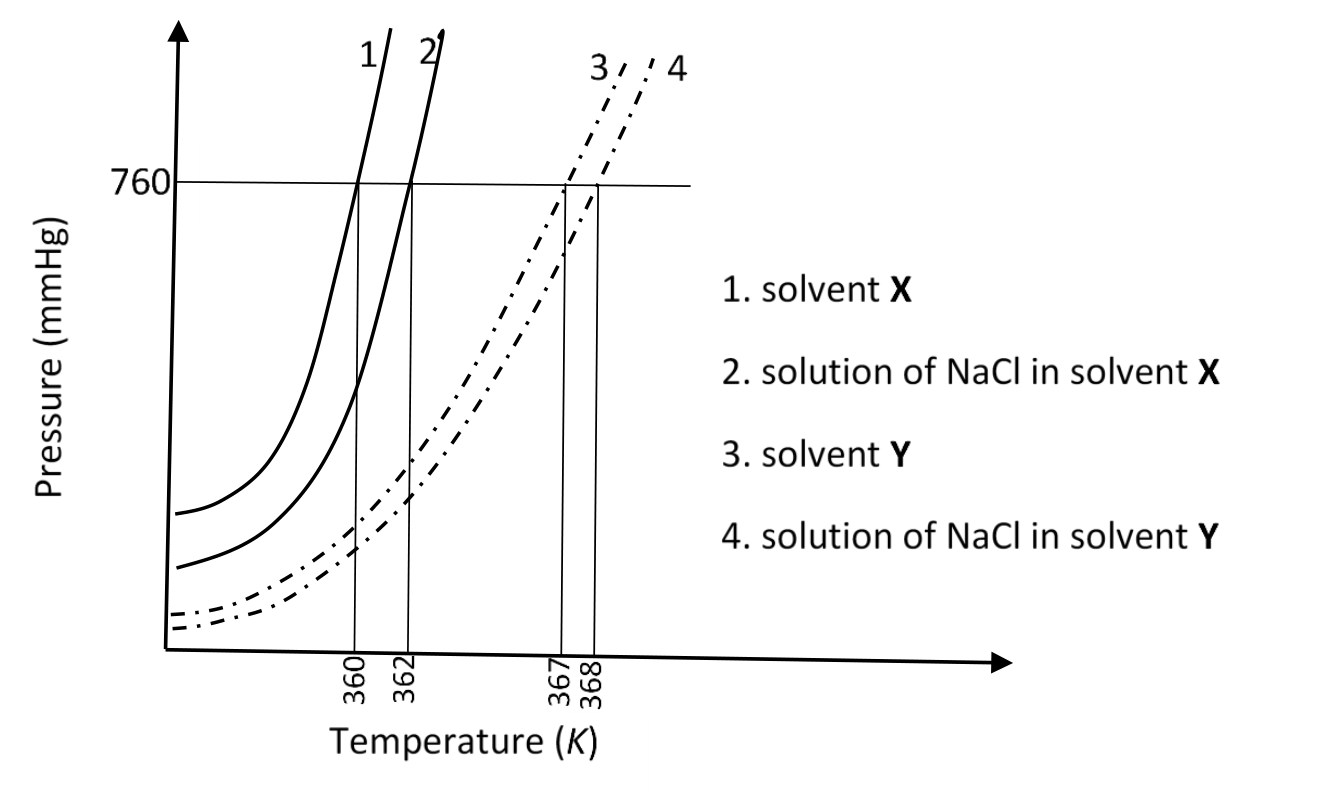
Vapour pressure (mmHg) against temperature (K). At 760 mmHg: curve 1 (solvent X) reaches it at 360 K, curve 2 (NaCl solution in X) at 362 K, curve 3 (solvent Y) at 367 K and curve 4 (NaCl solution in Y) at 368 K.
Answer and worked solution

Official answer: 0.05

Ebullioscopic constants. At 760 mmHg, solvent X boils at 360 K and its NaCl solution at 362 K, so ΔTb=2\Delta T_b=2 K. For Y the values are 367 K and 368 K, so ΔTb=1\Delta T_b=1 K.

The NaCl solutions are isomolal and i=2i=2 in both, so Kb(X)=2Kb(Y)K_b(X)=2K_b(Y).

Solute S. It has the same molality in both solvents. For dimerisation with degree α\alpha, i=1−α/2i=1-\alpha/2.
ΔTX=3ΔTY  ⟹  Kb(X) iX=3Kb(Y) iY  ⟹  2iX=3iY.\Delta T_X=3\Delta T_Y\implies K_b(X)\,i_X=3K_b(Y)\,i_Y\implies2i_X=3i_Y.

Solve. iY=1−0.35=0.65i_Y=1-0.35=0.65, so iX=0.975=1−αX/2i_X=0.975=1-\alpha_X/2, giving αX=0.05\alpha_X=0.05.

Answer: 0.05