Skip to content
dronacharya.ai
← JEE Advanced 2017 · Paper 1
PhysicsSingle correct+3 / -1Question 18 of 54

JEE Advanced 2017 · Paper 1, Physics question 18

Passage

Answer Q.16, Q.17 and Q.18 by appropriately matching the information given in the three columns of the following table.

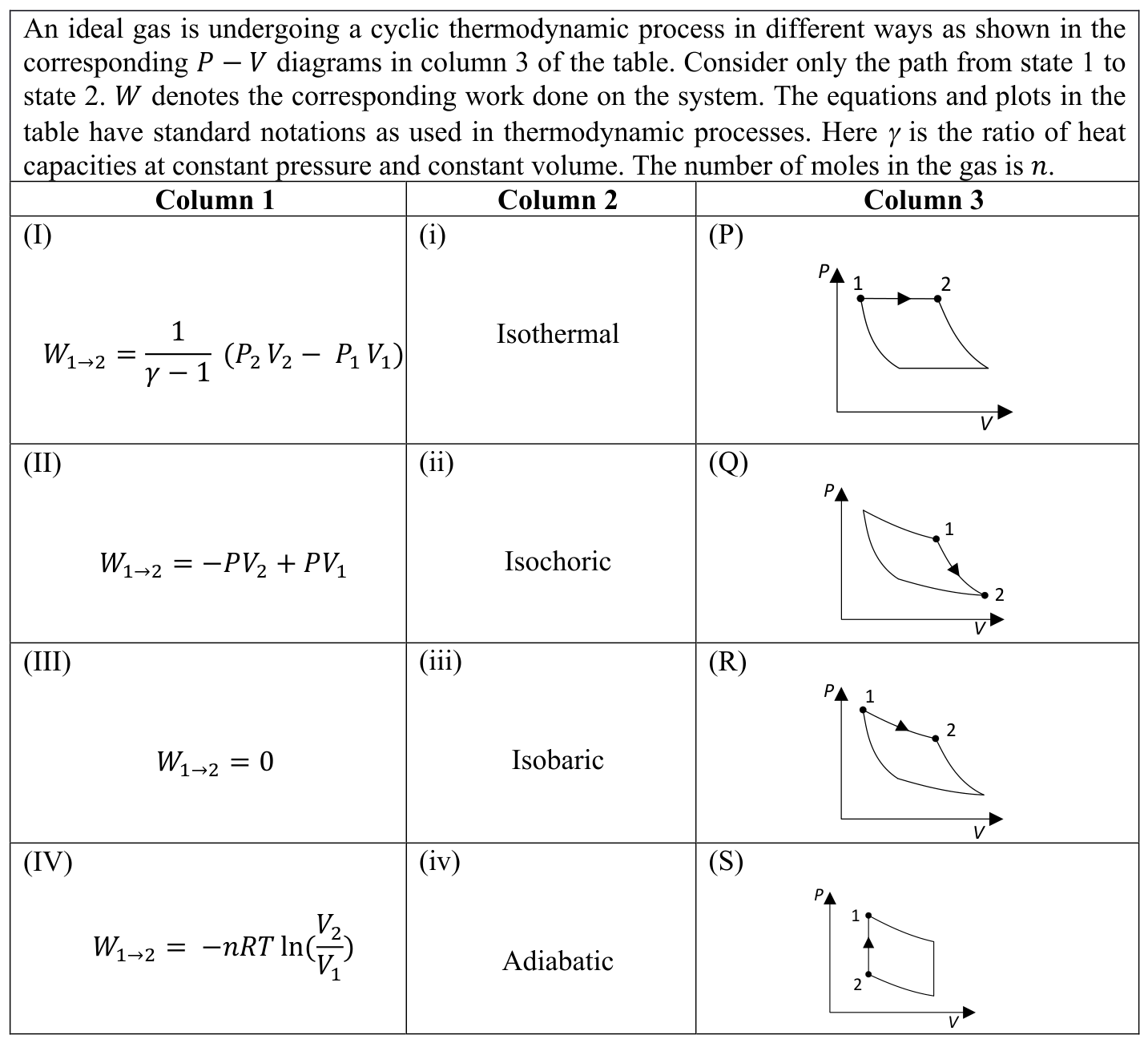
An ideal gas is undergoing a cyclic thermodynamic process in different ways as shown in the corresponding P−VP-V diagrams in column 3 of the table. Consider only the path from state 1 to state 2. WW denotes the corresponding work done on the system. The equations and plots in the table have standard notations as used in thermodynamic processes. Here γ\gamma is the ratio of heat capacities at constant pressure and constant volume. The number of moles in the gas is nn.

Column 1 Column 2 Column 3
(I) W1→2=1γ−1(P2V2−P1V1)W_{1\to2} = \frac{1}{\gamma - 1}(P_2V_2 - P_1V_1) (i) Isothermal (P) [P-V plot]
(II) W1→2=−PV2+PV1W_{1\to2} = -PV_2 + PV_1 (ii) Isochoric (Q) [P-V plot]
(III) W1→2=0W_{1\to2} = 0 (iii) Isobaric (R) [P-V plot]
(IV) W1→2=−nRTln⁡(V2V1)W_{1\to2} = -nRT\ln\left(\frac{V_2}{V_1}\right) (iv) Adiabatic (S) [P-V plot]
The three-column table for Q.16-18. Column 3 holds four P-V diagrams of a cycle, each highlighting the path from state 1 to state 2: (P) a horizontal arrow at the top of the cycle from 1 to 2 (constant pressure, expansion); (Q) a falling curve from 1 down to 2 along the lower-right side of the cycle (expansion along a curve); (R) a gently falling curve from 1 at the top left to 2 along the top of the cycle (expansion along a curve); (S) a vertical segment between 1 (above) and 2 (below) on the left side of the cycle, at constant volume.

Which one of the following options correctly represents a thermodynamic process that is used as a correction in the determination of the speed of sound in an ideal gas?

Choose one option
Answer and worked solution

Official answer: D

Laplace's correction treats sound as adiabatic (iv), so v=γP/ρv=\sqrt{\gamma P/\rho}.

For an adiabatic process the work done on the gas is W=P2V2−P1V1γ−1W=\dfrac{P_2V_2-P_1V_1}{\gamma-1}, which is (I).

The adiabatic path is the steeper curved side of the cycle, (Q).

(D)