Skip to content
dronacharya.ai
← JEE Advanced 2017 · Paper 1
ChemistrySingle correct+3 / -1Question 32 of 54

JEE Advanced 2017 · Paper 1, Chemistry question 14

Passage

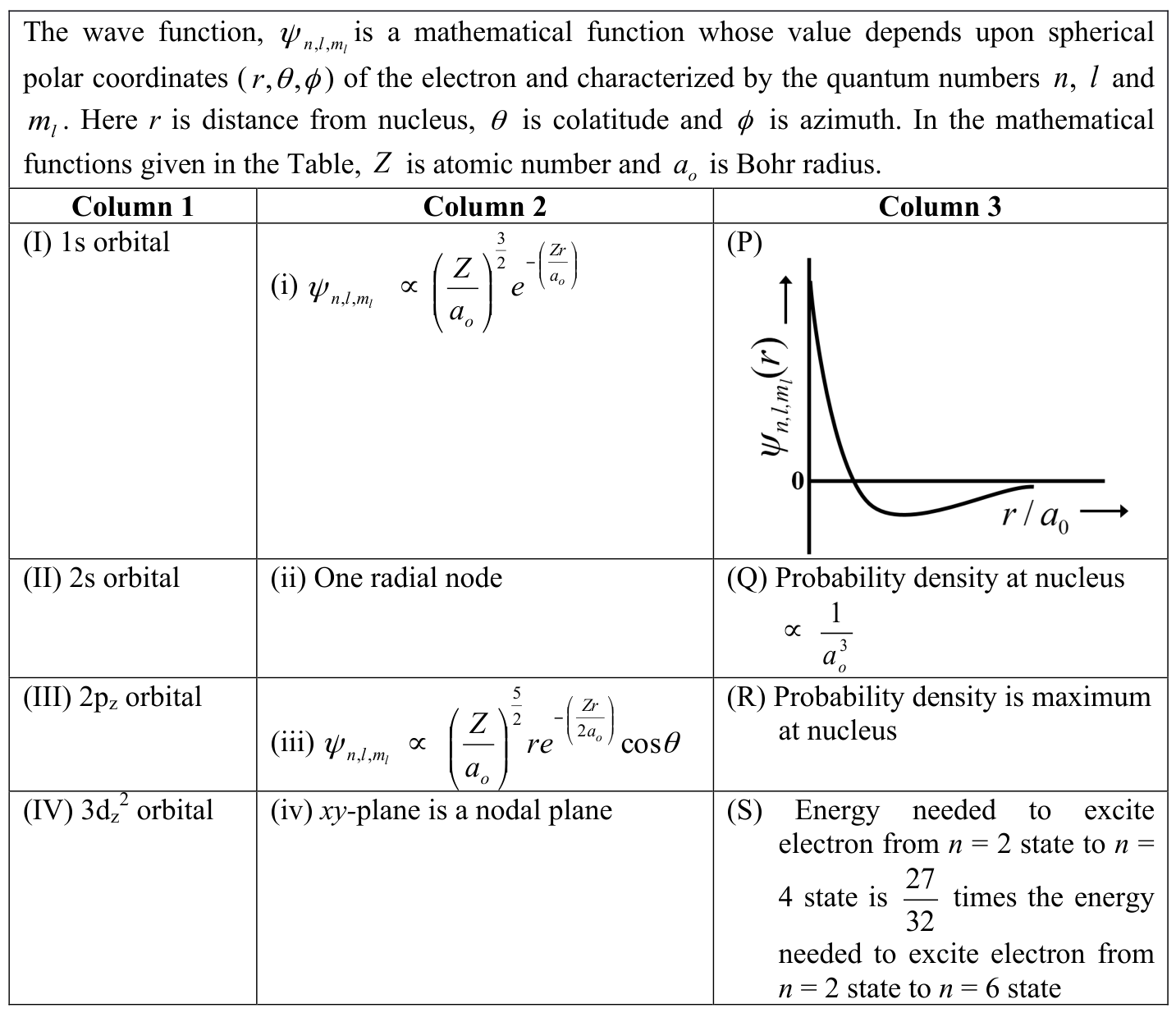
Answer Q.31, Q.32 and Q.33 by appropriately matching the information given in the three columns of the following table.

The wave function, ψn,l,ml\psi_{n,l,m_l} is a mathematical function whose value depends upon spherical polar coordinates (r,θ,ϕ)(r, \theta, \phi) of the electron and characterized by the quantum numbers nn, ll and mlm_l. Here rr is distance from nucleus, θ\theta is colatitude and ϕ\phi is azimuth. In the mathematical functions given in the Table, ZZ is atomic number and aoa_o is Bohr radius.

Column 1 Column 2 Column 3
(I) 1s orbital (i) ψn,l,ml∝(Zao)3/2e−(Zrao)\psi_{n,l,m_l} \propto \left(\frac{Z}{a_o}\right)^{3/2} e^{-\left(\frac{Zr}{a_o}\right)} (P) [plot of ψn,l,ml(r)\psi_{n,l,m_l}(r) against r/a0r/a_0]
(II) 2s orbital (ii) One radial node (Q) Probability density at nucleus ∝1ao3\propto \frac{1}{a_o^3}
(III) 2pz2p_z orbital (iii) ψn,l,ml∝(Zao)5/2re−(Zr2ao)cos⁡θ\psi_{n,l,m_l} \propto \left(\frac{Z}{a_o}\right)^{5/2} r e^{-\left(\frac{Zr}{2a_o}\right)} \cos\theta (R) Probability density is maximum at nucleus
(IV) 3dz23d_{z^2} orbital (iv) xyxy-plane is a nodal plane (S) Energy needed to excite electron from n=2n = 2 state to n=4n = 4 state is 2732\frac{27}{32} times the energy needed to excite electron from n=2n = 2 state to n=6n = 6 state
The three-column table for Q.31-33. Column 3 entry (P) is a plot of ψ(r) against r/a₀: the curve starts high at r = 0, falls steeply, crosses zero once (one radial node), dips to a shallow negative minimum and rises back towards zero.

For hydrogen atom, the only CORRECT combination is

Choose one option
Answer and worked solution

Official answer: A

1s orbital. Its wavefunction is (i), ψ∝(Z/a0)3/2e−Zr/a0\psi\propto(Z/a_0)^{3/2}e^{-Zr/a_0}.

Energy ratio (S).
E2→4E2→6=14−11614−136=3/168/36=2732.\frac{E_{2\to4}}{E_{2\to6}}=\frac{\frac14-\frac1{16}}{\frac14-\frac1{36}}=\frac{3/16}{8/36}=\frac{27}{32}.
This holds for hydrogen.

So (I)(i)(S) is correct. In the other options: (II) with (i) mismatches the function; (P) is a 2s plot; (iv) is wrong for 1s.

(A)