Skip to content
dronacharya.ai
← JEE Advanced 2016 · Paper 2
PhysicsSingle correct+3Question 15 of 54

JEE Advanced 2016 · Paper 2, Physics question 15

Passage

PARAGRAPH 1

A frame of reference that is accelerated with respect to an inertial frame of reference is called a non-inertial frame of reference. A coordinate system fixed on a circular disc rotating about a fixed axis with a constant angular velocity ω\omega is an example of a non-inertial frame of reference.

The relationship between the force F⃗rot\vec F_{rot} experienced by a particle of mass mm moving on the rotating disc and the force F⃗in\vec F_{in} experienced by the particle in an inertial frame of reference is
F⃗rot=F⃗in+2m(v⃗rot×ω⃗)+m(ω⃗×r⃗)×ω⃗,\vec F_{rot}=\vec F_{in}+2m(\vec v_{rot}\times\vec\omega)+m(\vec\omega\times\vec r)\times\vec\omega,
where v⃗rot\vec v_{rot} is the velocity of the particle in the rotating frame of reference and r⃗\vec r is the position vector of the particle with respect to the centre of the disc.

Now consider a smooth slot along a diameter of a disc of radius RR rotating counter-clockwise with a constant angular speed ω\omega about its vertical axis through its center. We assign a coordinate system with the origin at the center of the disc, the xx-axis along the slot, the yy-axis perpendicular to the slot and the zz-axis along the rotation axis (ω⃗=ωk^)(\vec\omega=\omega\hat k). A small block of mass mm is gently placed in the slot at r⃗=(R/2)i^\vec r=(R/2)\hat i at t=0t=0 and is constrained to move only along the slot.
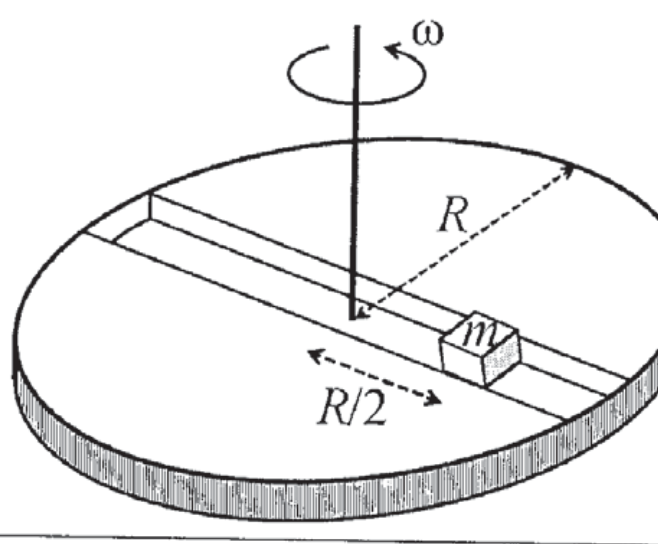
A horizontal disc of radius R rotating counter-clockwise with angular speed ω about a vertical axis through its centre. A straight slot runs along a diameter; a small block of mass m sits in the slot at distance R/2 from the centre.

The distance rr of the block at time tt is

Choose one option
Answer and worked solution

Official answer: A

Equation of motion in the slot. In the rotating frame, the forces along the slot (xx) come from the centrifugal term m(ω⃗×r⃗)×ω⃗=mω2x i^m(\vec\omega\times\vec r)\times\vec\omega=m\omega^2x\,\hat i. So
x¨=ω2x,x(0)=R2,x˙(0)=0.\ddot x=\omega^2x,\qquad x(0)=\frac R2,\quad\dot x(0)=0.

Solution.
x=R2cosh⁡ωt=R4(eωt+e−ωt).x=\frac R2\cosh\omega t=\frac R4\left(e^{\omega t}+e^{-\omega t}\right).

(A)