Two thin circular discs of mass and , having radii of and , respectively, are rigidly fixed by a massless, rigid rod of length through their centers. This assembly is laid on a firm and flat surface, and set rolling without slipping on the surface so that the angular speed about the axis of the rod is . The angular momentum of the entire assembly about the point 'O' is (see the figure). Which of the following statement(s) is(are) true?
← JEE Advanced 2016 · Paper 2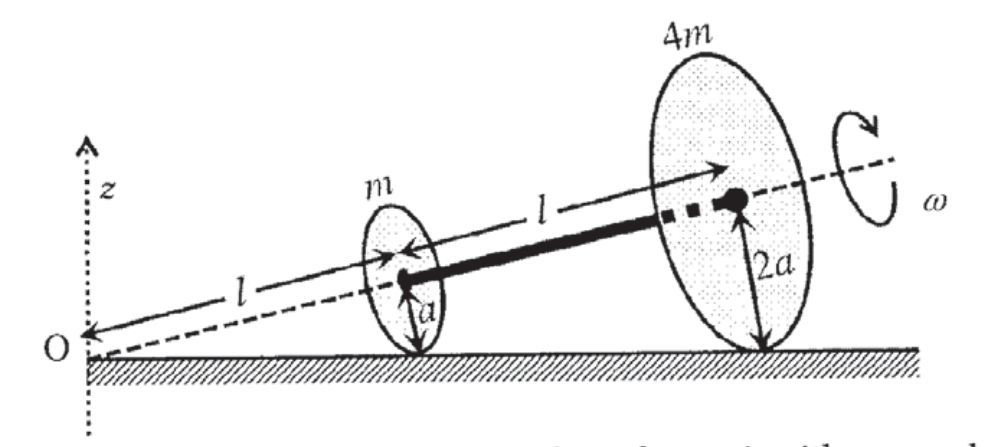
PhysicsMultiple correct+4 / -2Question 7 of 54
JEE Advanced 2016 · Paper 2, Physics question 7
Answer and worked solution
Official answer: A
Precession. The assembly rolls like a cone with apex at O, where the line of the rod meets the surface. The instantaneous axis is the line of contact through O, so the total angular velocity has no vertical part. The precession about must cancel the vertical part of the spin:
where is the rod's inclination. Taking O as 5a from the small disc's centre (height ), and . (A) is true.
About the centre of mass. The spin angular momentum is
as in (C) (ignoring the small contribution of the precession).
The other options. (B) and (D) do not hold once the cosine of the inclination is included.
Why the key accepts two answers. The figure's lengths are not consistent: a rod of does not match the heights and with O at 5a. The key therefore accepts (A) or (A), (C).
Answer: (A) (the key accepts A, or A and C)