Skip to content
dronacharya.ai
← JEE Advanced 2015 · Paper 2
PhysicsMultiple correct+4 / -2Question 17 of 60

JEE Advanced 2015 · Paper 2, Physics question 17

Passage

PARAGRAPH 1

In a thin rectangular metallic strip a constant current II flows along the positive xx-direction, as shown in the figure. The length, width and thickness of the strip are ll, ww and dd, respectively. A uniform magnetic field B⃗\vec B is applied on the strip along the positive yy-direction. Due to this, the charge carriers experience a net deflection along the zz-direction. This results in accumulation of charge carriers on the surface PQRSPQRS and appearance of equal and opposite charges on the face opposite to PQRSPQRS. A potential difference along the zz-direction is thus developed. Charge accumulation continues until the magnetic force is balanced by the electric force. The current is assumed to be uniformly distributed on the cross section of the strip and carried by electrons.
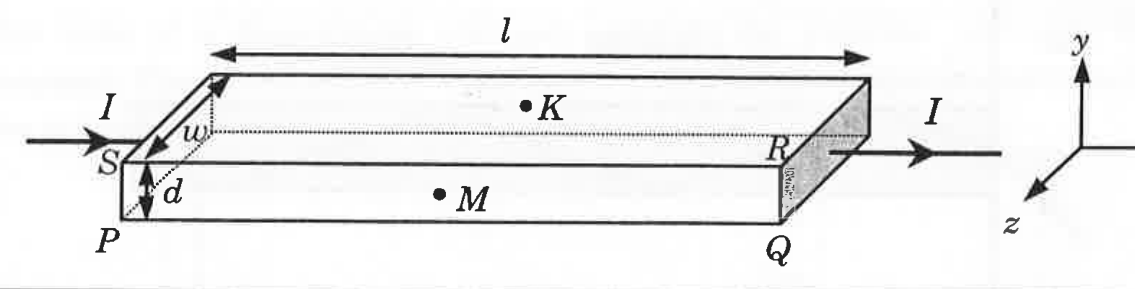
A flat metallic strip of length l along x, width w along z and thickness d along y, carrying current I in the +x direction. The near face PQRS (in the x-y plane, facing +z) carries point M; the opposite face carries point K. Axes: x right, y up, z out of the page.

Consider two different metallic strips (1 and 2) of the same material. Their lengths are the same, widths are w1w_1 and w2w_2 and thicknesses are d1d_1 and d2d_2, respectively. Two points KK and MM are symmetrically located on the opposite faces parallel to the xx-yy plane (see figure). V1V_1 and V2V_2 are the potential differences between KK and MM in strips 1 and 2, respectively. Then, for a given current II flowing through them in a given magnetic field strength BB, the correct statement(s) is(are)

Choose one or more options
Answer and worked solution

Official answer: A, D

Hall voltage. In equilibrium eE=evBeE=evB, so the voltage across the width is V=BvwV=Bvw. With I=nevwdI=nevwd:
V=IBned.V=\frac{IB}{ned}.
It depends on the thickness dd but not on the width ww.

  • (A) d1=2d2d_1=2d_2 gives V2=2V1V_2=2V_1. True.
  • (D) w1=2w2w_1=2w_2 with equal dd gives V2=V1V_2=V_1. True.

(A), (D)