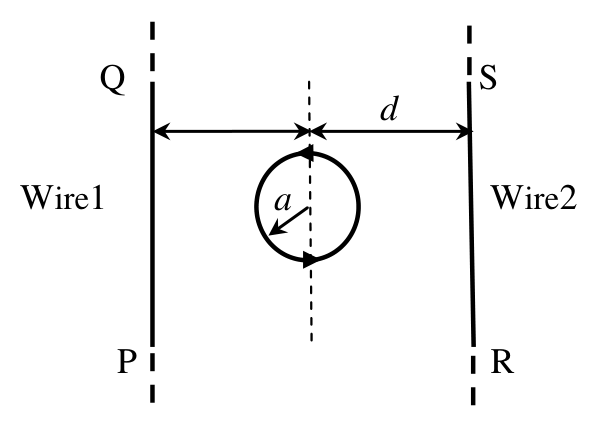
The figure shows a circular loop of radius a with two long parallel wires (numbered 1 and 2) all in the plane of the paper. The distance of each wire from the centre of the loop is d. The loop and the wires are carrying the same current I. The current in the loop is in the counterclockwise direction if seen from above.
When d≈a but wires are not touching the loop, it is found that the net magnetic field on the axis of the loop is zero at a height h above the loop. In that case
Answer and worked solution
Official answer: C
Direction of the wire currents. Take the axis of the loop (perpendicular to the paper through the centre). At a point on it, each wire's field is perpendicular to the line joining the wire to the point. The components along the axis add only if the currents are opposite; the components parallel to the paper then cancel. So the currents must be antiparallel: PQ and SR. (With parallel currents the axial components cancel and nothing can cancel the loop's field.)
Field of the wires on the axis at height h: Bw=2⋅2πd2+h2μ0I⋅d2+h2d=π(d2+h2)μ0Id.
Field of the loop:Bℓ=2(a2+h2)3/2μ0Ia2.
Set them equal with d=a. π(a2+h2)a=2(a2+h2)3/2a2⟹a2+h2=2πa⟹h=a4π2−1≈1.2a.