Airplanes A and B are flying with constant velocity in the same vertical plane at angles 30° and 60° with respect to the horizontal respectively as shown in figure. The speed of A is . At time s, an observer in A finds B at a distance of 500 m. This observer sees B moving with a constant velocity perpendicular to the line of motion of A. If at , A just escapes being hit by B, in seconds is
← JEE Advanced 2014 · Paper 1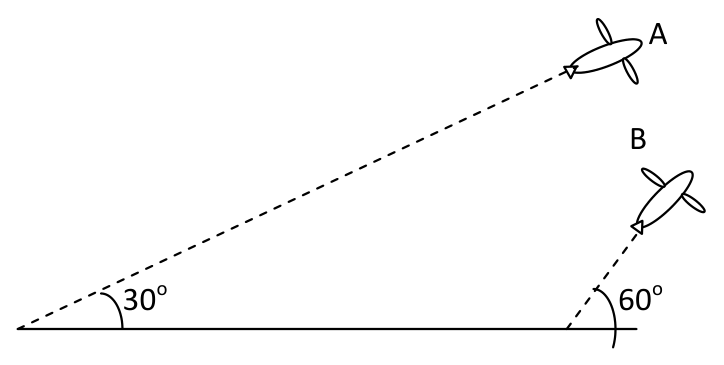
PhysicsInteger+3Question 11 of 60
JEE Advanced 2014 · Paper 1, Physics question 11
Answer and worked solution
Official answer: 5
Relative velocity. B's velocity makes 30° with A's. For B to appear to move perpendicular to A's line, the components along A's direction must match:
Relative speed. , perpendicular to A's path.
Time. B, 500 m away along that perpendicular, closes the gap at 100 m s⁻¹:
Answer: 5
Topics:Relative velocity