Skip to content
dronacharya.ai
← JEE Advanced 2014 · Paper 1
PhysicsMultiple correct+3Question 1 of 60

JEE Advanced 2014 · Paper 1, Physics question 1

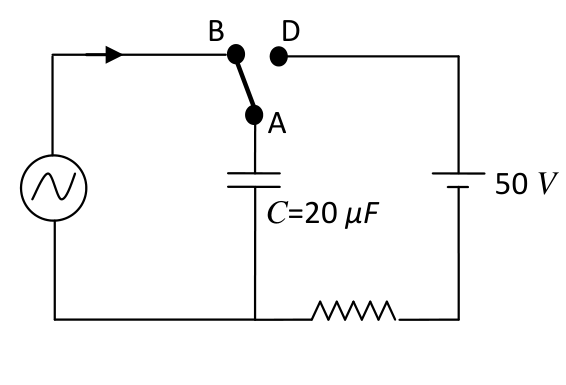
At time t=0t=0, terminal A in the circuit shown in the figure is connected to B by a key and an alternating current I(t)=I0cos⁡(ωt)I(t)=I_0\cos(\omega t), with I0=1I_0=1 A and ω=500 rad s−1\omega=500\ \mathrm{rad\,s^{-1}} starts flowing in it with the initial direction shown in the figure. At t=7π6ωt=\dfrac{7\pi}{6\omega}, the key is switched from B to D. Now onwards only A and D are connected. A total charge QQ flows from the battery to charge the capacitor fully. If C=20 μC=20\ \muF, R=10 ΩR=10\ \Omega and the battery is ideal with emf of 50 V, identify the correct statement(s).

Left loop: an AC source (∿) feeding the top wire (current arrow pointing right) to terminal B of a two-way key; the key's common terminal A connects down to the capacitor C = 20 μF, whose lower plate returns to the bottom wire. Right loop: terminal D connects along the top to a 50 V battery on the right side, which returns along the bottom through R = 10 Ω to the capacitor's lower node.
Choose one or more options
Answer and worked solution

Official answer: C, D

Charge while A-B are joined. The current is the rate of charging, so
q(t)=∫0tI0cos⁡ωt dt=I0ωsin⁡ωt.q(t)=\int_0^tI_0\cos\omega t\,dt=\frac{I_0}{\omega}\sin\omega t.

  • (A) The maximum is I0/ω=1/500=2×10−3I_0/\omega=1/500=2\times10^{-3} C, not 1×10⁻³¹\times10^{-3} C. False.
  • (B) At t=7π6ωt=\frac{7\pi}{6\omega}, cos⁡7π6=−32<0\cos\frac{7\pi}6=-\frac{\sqrt3}2<0, so the current has reversed from the direction shown, which was clockwise. It is anticlockwise. False.
  • (C) At that instant q=1500sin⁡7π6=−1×10⁻³q=\frac{1}{500}\sin\frac{7\pi}6=-1\times10^{-3} C, so the capacitor voltage is 10−320×10−6=50\frac{10^{-3}}{20\times10^{-6}}=50 V with the polarity that adds to the battery. The initial current is 50+5010=10\frac{50+50}{10}=10 A. True.
  • (D) Fully charged by the battery, the capacitor holds CV=+1×10⁻³CV=+1\times10^{-3} C. Going from −1×10⁻³-1\times10^{-3} C to +1×10⁻³+1\times10^{-3} C needs Q=2×10⁻³Q=2\times10^{-3} C. True.

(C), (D)