Skip to content
dronacharya.ai
← JEE Advanced 2014 · Paper 1
ChemistryMultiple correct+3Question 22 of 60

JEE Advanced 2014 · Paper 1, Chemistry question 22

The reactivity of compound Z with different halogens under appropriate conditions is given below:

Z + X₂ → mono halo substituted derivative when X₂ = I₂; di halo substituted derivative when X₂ = Br₂; tri halo substituted derivative when X₂ = Cl₂.

The observed pattern of electrophilic substitution can be explained by
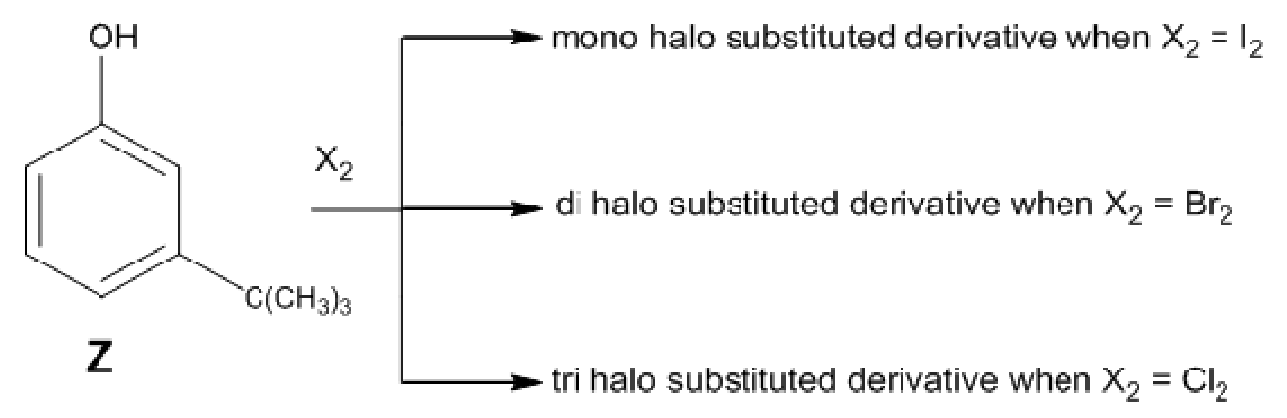
Compound Z, 3-tert-butylphenol (OH at C1, C(CH₃)₃ at C3), reacts with X₂ to give a mono-halo derivative with I₂, a di-halo derivative with Br₂ and a tri-halo derivative with Cl₂.
Choose one or more options
Answer and worked solution

Official answer: A, B, C

Available positions. The OH group strongly activates its ortho and para positions: C2, C4 and C6. The bulky tert-butyl group at C3 sits next to C2 and C4.

Pattern.

  • ClX2\ce{Cl2}, the smallest halogen, can reach all three positions: tri-substitution.
  • BrX2\ce{Br2} is larger and cannot reach the crowded C2 (between OH and t-Bu): di-substitution.
  • IX2\ce{I2}, the largest and least reactive, substitutes only the open position: mono-substitution.

What explains it.

  • (A) The size of the halogen matters. Yes.
  • (B) The crowding comes from the tert-butyl group. Yes.
  • (C) The positions attacked are those activated by the phenolic OH. Yes.
  • (D) The tert-butyl group's weak +I effect does not decide which positions react. No.

(A), (B), (C)