Which of the given statement(s) about N, O, P and Q with respect to M is (are) correct?
← IIT-JEE 2012 · Paper 2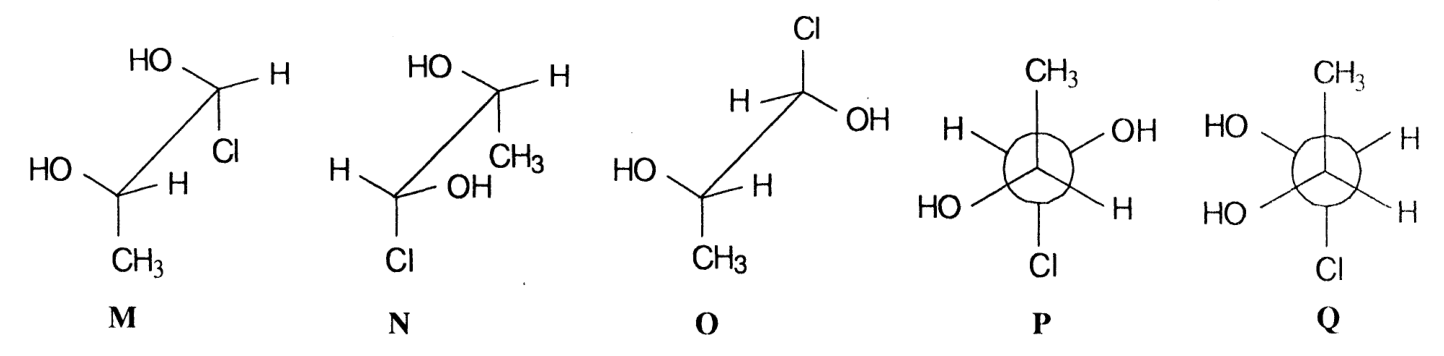
ChemistryMultiple correct+4Question 40 of 60
IIT-JEE 2012 · Paper 2, Chemistry question 40
Answer and worked solution
Official answer: A, B, C
The compound is , with stereocentres C1 (bearing Cl) and C2 (bearing ). Priorities: at C1, Cl > OH > C2 > H; at C2, OH > C1 > > H.
Configurations read from the drawings.
- M (C2 in front: HO upper-left, H right, down; C1 behind: HO upper-left, H right, Cl down): (1R,2S).
- N (C1 in front: H upper-left, OH right, Cl down; C2 behind: HO upper-left, H right, down): (1R,2R).
- O (same front C2 as M; C1 behind: H left, OH right, Cl up): (1R,2S). This is M with the back carbon rotated 180°.
- P (Newman, C2 in front: top, HO lower-left, H lower-right; C1 behind: H upper-left, OH upper-right, Cl bottom): (1S,2R).
- Q (same front as P; C1 behind: HO upper-left, H upper-right, Cl bottom): (1R,2R).
Comparisons with M (1R,2S).
- (A) N (1R,2R) differs at one centre: a diastereomer, i.e. a non-mirror-image stereoisomer. True.
- (B) O (1R,2S) is the same molecule in another conformation. True.
- (C) P (1S,2R) has both centres inverted: the enantiomer. True.
- (D) Q (1R,2R) is a diastereomer, not identical. False.
(A), (B), (C)