Skip to content
dronacharya.ai
← IIT-JEE 2012 · Paper 1
PhysicsInteger+4Question 16 of 60

IIT-JEE 2012 · Paper 1, Physics question 16

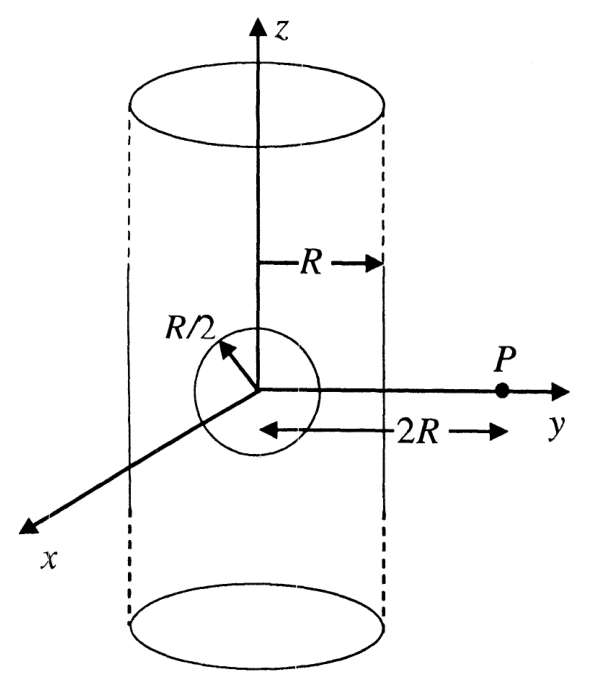
An infinitely long solid cylinder of radius RR has a uniform volume charge density ρ\rho. It has a spherical cavity of radius R/2R/2 with its centre on the axis of the cylinder, as shown in the figure. The magnitude of the electric field at the point PP, which is at a distance 2R2R from the axis of the cylinder, is given by the expression 23ρR16kε0\dfrac{23\rho R}{16k\varepsilon_0}. The value of kk is

A long vertical cylinder of radius R along the z-axis containing a spherical cavity of radius R/2 centred on the axis at the origin; point P lies on the y-axis at distance 2R from the axis.
Answer and worked solution

Official answer: 6

Superposition. Treat the cavity as the full cylinder plus a sphere of charge density −ρ-\rho.

Cylinder. Per unit length λ=ρπR2\lambda=\rho\pi R^2; at distance 2R2R:
Ec=λ2πε0(2R)=ρR4ε0.E_c=\frac{\lambda}{2\pi\varepsilon_0(2R)}=\frac{\rho R}{4\varepsilon_0}.

Cavity sphere. Charge ρ⋅43π(R2)3=ρπR36\rho\cdot\frac43\pi\left(\frac R2\right)^3=\frac{\rho\pi R^3}6; at distance 2R2R:
Es=ρπR3/64πε0(2R)2=ρR96ε0.E_s=\frac{\rho\pi R^3/6}{4\pi\varepsilon_0(2R)^2}=\frac{\rho R}{96\varepsilon_0}.

Net. E=ρRε0(14−196)=23ρR96ε0=23ρR16⋅6 ε0E=\dfrac{\rho R}{\varepsilon_0}\left(\dfrac14-\dfrac1{96}\right)=\dfrac{23\rho R}{96\varepsilon_0}=\dfrac{23\rho R}{16\cdot6\,\varepsilon_0}, so k=6k=6.

Answer: 6