Column I shows four systems, each of the same length L, for producing standing waves. The lowest possible natural frequency of a system is called its fundamental frequency, whose wavelength is denoted as . Match each system with statements given in Column II describing the nature and wavelength of the standing waves.
← IIT-JEE 2011 · Paper 2
PhysicsMatrix match+8Question 40 of 60
IIT-JEE 2011 · Paper 2, Physics question 40
Column I
- APipe closed at one end
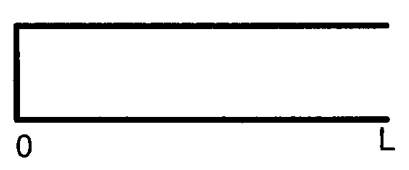
- BPipe open at both ends
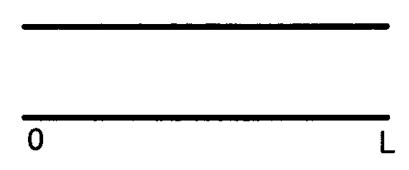
- CStretched wire clamped at both ends
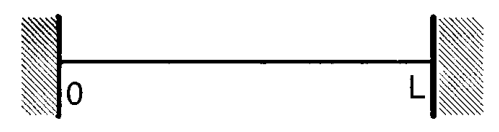
- DStretched wire clamped at both ends and at mid-point
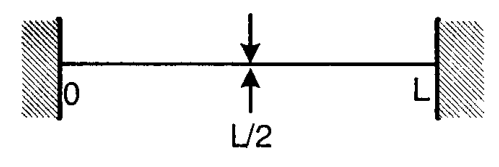
Column II
- PLongitudinal waves
- QTransverse waves
- R
- S
- T
| P | Q | R | S | T | |
|---|---|---|---|---|---|
| A | |||||
| B | |||||
| C | |||||
| D |
Answer and worked solution
Official answer: A → P, T; B → P, S; C → Q, S; D → Q, R
- A Closed pipe: sound waves are longitudinal. The fundamental has a node at the closed end and an antinode at the open end: , so . → P, T.
- B Open pipe: antinodes at both ends, , so . → P, S.
- C String clamped at both ends: transverse waves, nodes at both ends, . → Q, S.
- D Clamped also at the middle: a node at , so the lowest mode has and . → Q, R.
Answer: A → P, T; B → P, S; C → Q, S; D → Q, R