A metal rod of length 'L' and mass 'm' is pivoted at one end. A thin disk of mass 'M' and radius 'R' (< L) is attached at its center to the free end of the rod. Consider two ways the disc is attached: (case A) The disc is not free to rotate about its center and (case B) the disc is free to rotate about its center. The rod-disc system performs SHM in vertical plane after being released from the same displaced position. Which of the following statement(s) is (are) true?
← IIT-JEE 2011 · Paper 1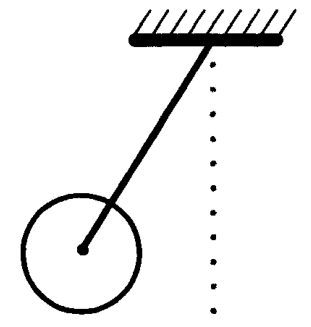
PhysicsMultiple correct+4Question 34 of 69
IIT-JEE 2011 · Paper 1, Physics question 34
Answer and worked solution
Official answer: A, D
Torque. Gravity acts on the same masses at the same positions in both cases: equal restoring torques (A).
Moment of inertia. If the disc can turn freely about its centre, no torque acts on it about that centre, so it does not rotate and contributes only . If it is fixed to the rod it also contributes . Smaller in case B gives a larger angular frequency (D).
(A), (D)