Two transparent media of refractive indices and have a solid lens shaped transparent material of refractive index between them as shown in figures in Column II. A ray traversing these media is also shown in the figures. In Column I different relationships between , and are given. Match them to the ray diagrams shown in Column II.
← IIT-JEE 2010 · Paper 2
PhysicsMatrix match+8Question 56 of 57
IIT-JEE 2010 · Paper 2, Physics question 56
Column I
- A
- B
- C
- D
Column II
- P
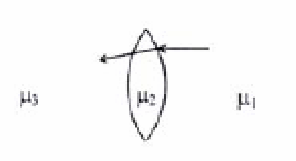
- Q
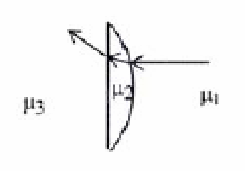
- R
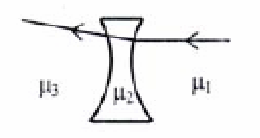
- S
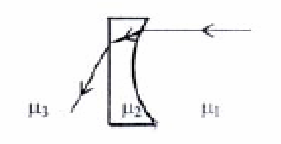
- T
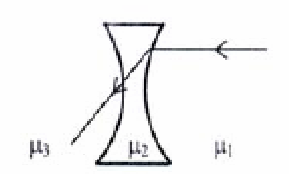
| P | Q | R | S | T | |
|---|---|---|---|---|---|
| A | |||||
| B | |||||
| C | |||||
| D |
Answer and worked solution
Official answer: A → P, R; B → Q, S, T; C → P, R, T; D → Q, S
In every figure the ray comes from (right), crosses the lens () and leaves into (left).
Reading each diagram.
- P (biconvex): bends towards the axis at the first surface (converging, so for a convex face) and is undeviated at the second ().
- Q (convex face first, then plane): bends away from the axis at the convex face (so ), and further away at the plane face (the ray, already inclined, goes into a rarer medium: ).
- R (biconcave): bends away from the axis at the first, concave surface (diverging, so ) and is undeviated at the second ().
- S (concave face first, then plane): bends towards the axis at the concave face (a concave surface converges when ), and bends further at the plane face ().
- T (biconcave): bends strongly towards the axis at the first surface () and is undeviated at the second ().
Matching.
- A (): P, R.
- B (): Q, S, T.
- C (): P, R, T.
- D (): Q, S.
Answer: A → P, R; B → Q, S, T; C → P, R, T; D → Q, S