Skip to content
dronacharya.ai
← IIT-JEE 2009 · Paper 2
PhysicsMatrix match+8Question 49 of 57

IIT-JEE 2009 · Paper 2, Physics question 49

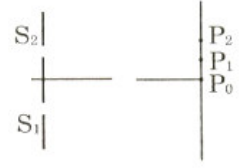
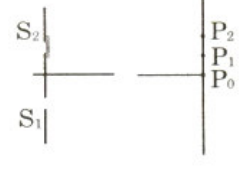
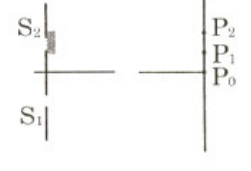
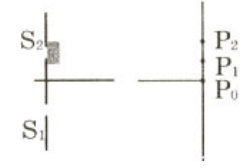
Column I shows four situations of standard Young's double slit arrangement with the screen placed far away from the slits S1\mathrm S_1 and S2\mathrm S_2. In each of these cases S1P0=S2P0\mathrm{S_1P_0}=\mathrm{S_2P_0}, S1P1−S2P1=λ/4\mathrm{S_1P_1}-\mathrm{S_2P_1}=\lambda/4 and S1P2−S2P2=λ/3\mathrm{S_1P_2}-\mathrm{S_2P_2}=\lambda/3, where λ\lambda is the wavelength of the light used. In the cases B, C and D, a transparent sheet of refractive index μ\mu and thickness tt is pasted on slit S2\mathrm S_2. The thicknesses of the sheets are different in different cases. The phase difference between the light waves reaching a point P on the screen from the two slits is denoted by δ(P)\delta(\mathrm P) and the intensity by I(P)I(\mathrm P). Match each situation given in Column I with the statement(s) in Column II valid for that situation.

Column I

  • A
    (no sheet)
    Young's double slit: slits S₂ (upper) and S₁ (lower) on the left, a screen on the right with points P₀ (on the axis), P₁ and P₂ above it in that order; no sheet on either slit.
  • B
    (μ−1)t=λ/4(\mu-1)t=\lambda/4
    Young's double slit: slits S₂ (upper) and S₁ (lower) on the left, a screen on the right with points P₀ (on the axis), P₁ and P₂ above it in that order; a thin transparent sheet covers S₂.
  • C
    (μ−1)t=λ/2(\mu-1)t=\lambda/2
    Young's double slit: slits S₂ (upper) and S₁ (lower) on the left, a screen on the right with points P₀ (on the axis), P₁ and P₂ above it in that order; a thicker transparent sheet covers S₂.
  • D
    (μ−1)t=3λ/4(\mu-1)t=3\lambda/4
    Young's double slit: slits S₂ (upper) and S₁ (lower) on the left, a screen on the right with points P₀ (on the axis), P₁ and P₂ above it in that order; the thickest transparent sheet covers S₂.

Column II

  • P
    δ(P0)=0\delta(\mathrm P_0)=0
  • Q
    δ(P1)=0\delta(\mathrm P_1)=0
  • R
    I(P1)=0I(\mathrm P_1)=0
  • S
    I(P0)>I(P1)I(\mathrm P_0)>I(\mathrm P_1)
  • T
    I(P2)>I(P1)I(\mathrm P_2)>I(\mathrm P_1)
Mark every match for each entry
PQRST
A
B
C
D
Answer and worked solution

Official answer: A → P, S; B → Q; C → T; D → R, S, T

Path difference at a point (S₁ path minus S₂ path): 0 at P₀, λ4\frac\lambda4 at P₁, λ3\frac\lambda3 at P₂. A sheet on S₂ adds (μ−1)t(\mu-1)t to the S₂ path, so the effective difference is Δ−(μ−1)t\Delta-(\mu-1)t. With I=4I0cos⁡2δ2I=4I_0\cos^2\frac\delta2 and δ=2πλ×\delta=\frac{2\pi}\lambda\times (difference):

P₀ P₁ P₂
A (no sheet) 0 → 4I04I_0 λ4\frac\lambda4 → 2I02I_0 λ3\frac\lambda3 → I0I_0
B (λ4\frac\lambda4) −λ4-\frac\lambda4 → 2I02I_0 0 → 4I04I_0 λ12\frac\lambda{12} → 3.7I03.7I_0
C (λ2\frac\lambda2) −λ2-\frac\lambda2 → 0 −λ4-\frac\lambda4 → 2I02I_0 −λ6-\frac\lambda6 → 3I03I_0
D (3λ4\frac{3\lambda}4) −3λ4-\frac{3\lambda}4 → 2I02I_0 −λ2-\frac\lambda2 → 0 −5λ12-\frac{5\lambda}{12} → 0.27I00.27I_0
  • A: δ(P0)=0\delta(P_0)=0 and I(P0)>I(P1)I(P_0)>I(P_1). → P, S.
  • B: δ(P1)=0\delta(P_1)=0. → Q.
  • C: I(P2)>I(P1)I(P_2)>I(P_1). → T.
  • D: I(P1)=0I(P_1)=0, so both I(P0)I(P_0) and I(P2)I(P_2) exceed it. → R, S, T.

Answer: A → P, S; B → Q; C → T; D → R, S, T