Column I gives a list of possible set of parameters measured in some experiments. The variations of the parameters in the form of graphs are shown in Column II. Match the set of parameters given in Column I with the graphs given in Column II. Indicate your answer by darkening the appropriate bubbles of the 4 × 4 matrix given in the ORS.
← IIT-JEE 2008 · Paper 2
PhysicsMatrix match+6Question 42 of 66
IIT-JEE 2008 · Paper 2, Physics question 42
Column I
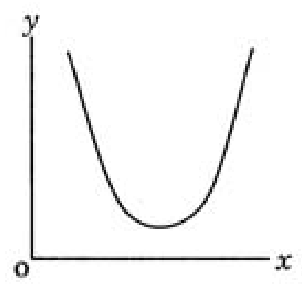
- APotential energy of a simple pendulum ( axis) as a function of displacement ( axis)
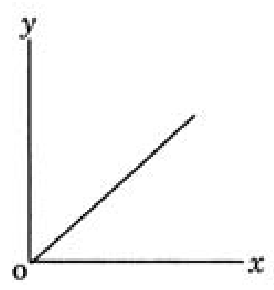
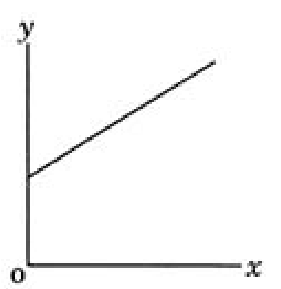
- BDisplacement ( axis) as a function of time ( axis) for a one dimensional motion at zero or constant acceleration when the body is moving along the positive -direction
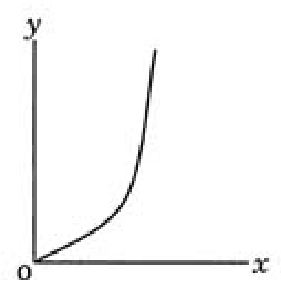
- CRange of a projectile ( axis) as a function of its velocity ( axis) when projected at a fixed angle
- DThe square of the time period ( axis) of a simple pendulum as a function of its length ( axis)
Column II
- P(graph p)
- Q(graph q)
- R(graph r)
- S(graph s)
| P | Q | R | S | |
|---|---|---|---|---|
| A | ||||
| B | ||||
| C | ||||
| D |
Answer and worked solution
Official answer: A → P, S; B → Q, R, S; C → S; D → Q
- A. A pendulum's potential energy is quadratic in displacement, about the mean position: a parabola. Graph S (from the origin, concave up) and graph P (a U-shaped curve, i.e. the same parabola with the reference shifted). → P, S.
- B. with : with a straight line through the origin (Q) or with an intercept (R); with constant a curve rising ever more steeply (S). → Q, R, S.
- C. : a parabola from the origin. → S.
- D. : a straight line through the origin. → Q.
Answer: A → P, S; B → Q, R, S; C → S; D → Q