Skip to content
dronacharya.ai
← IIT-JEE 2008 · Paper 2
PhysicsSingle correct+4 / -1Question 39 of 66

IIT-JEE 2008 · Paper 2, Physics question 39

Passage

Paragraph for Question Nos. 39 to 41

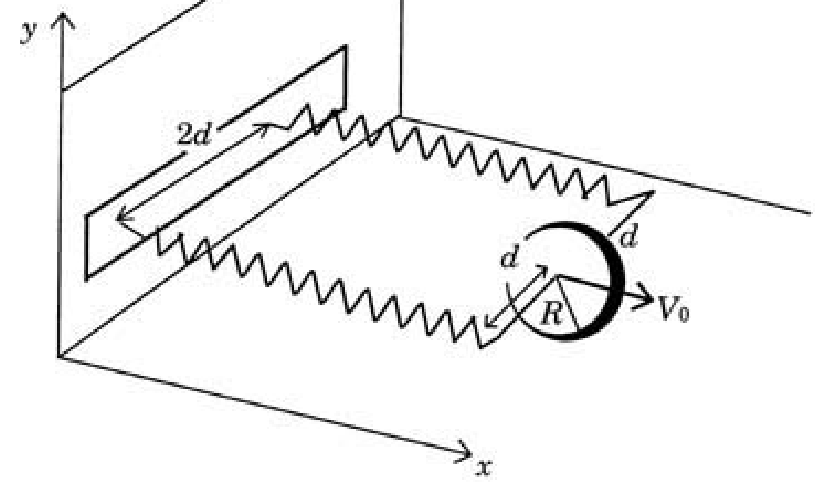
A uniform thin cylindrical disk of mass MM and radius RR is attached to two identical massless springs of spring constant kk which are fixed to the wall as shown in the figure. The springs are attached to the axle of the disk symmetrically on either side at a distance dd from its centre. The axle is massless and both the springs and the axle are in a horizontal plane. The unstretched length of each spring is LL. The disk is initially at its equilibrium position with its centre of mass (CM) at a distance LL from the wall. The disk rolls without slipping with velocity V⃗0=V0i^\vec V_0=V_0\hat i. The coefficient of friction is μ\mu.

A disk of radius R standing on a horizontal floor; its massless axle extends a distance d on either side of the centre, and from each end a spring runs back to a plate on the vertical wall (the spring attachments on the wall are 2d apart). The disk moves away from the wall with velocity V₀ along x.

The net external force acting on the disk when its centre of mass is at displacement xx with respect to its equilibrium position is

Choose one option
Answer and worked solution

Official answer: D

Energy of the rolling disk. Two springs give potential energy 2⋅12kx2=kx22\cdot\frac12kx^2=kx^2. Rolling without slipping, the kinetic energy is 12Mv2+12⋅12MR2⋅v2R2=34Mv2\frac12Mv^2+\frac12\cdot\frac12MR^2\cdot\frac{v^2}{R^2}=\frac34Mv^2.

Equation of motion. ddt(kx2+34Mv2)=0\frac{d}{dt}\left(kx^2+\frac34Mv^2\right)=0 gives 32Ma=−2kx\frac32Ma=-2kx, so the net external force (springs plus friction) is
Ma=−43kx.Ma=-\frac43kx.

(D)